I have seen it happen repeatedly. A brand spends weeks planning a campaign, aligning messaging, and preparing content calendars, only to realize that by the time everything is ready, the trend they wanted to leverage has already faded. This is not a rare situation. It is the reality of social media today.
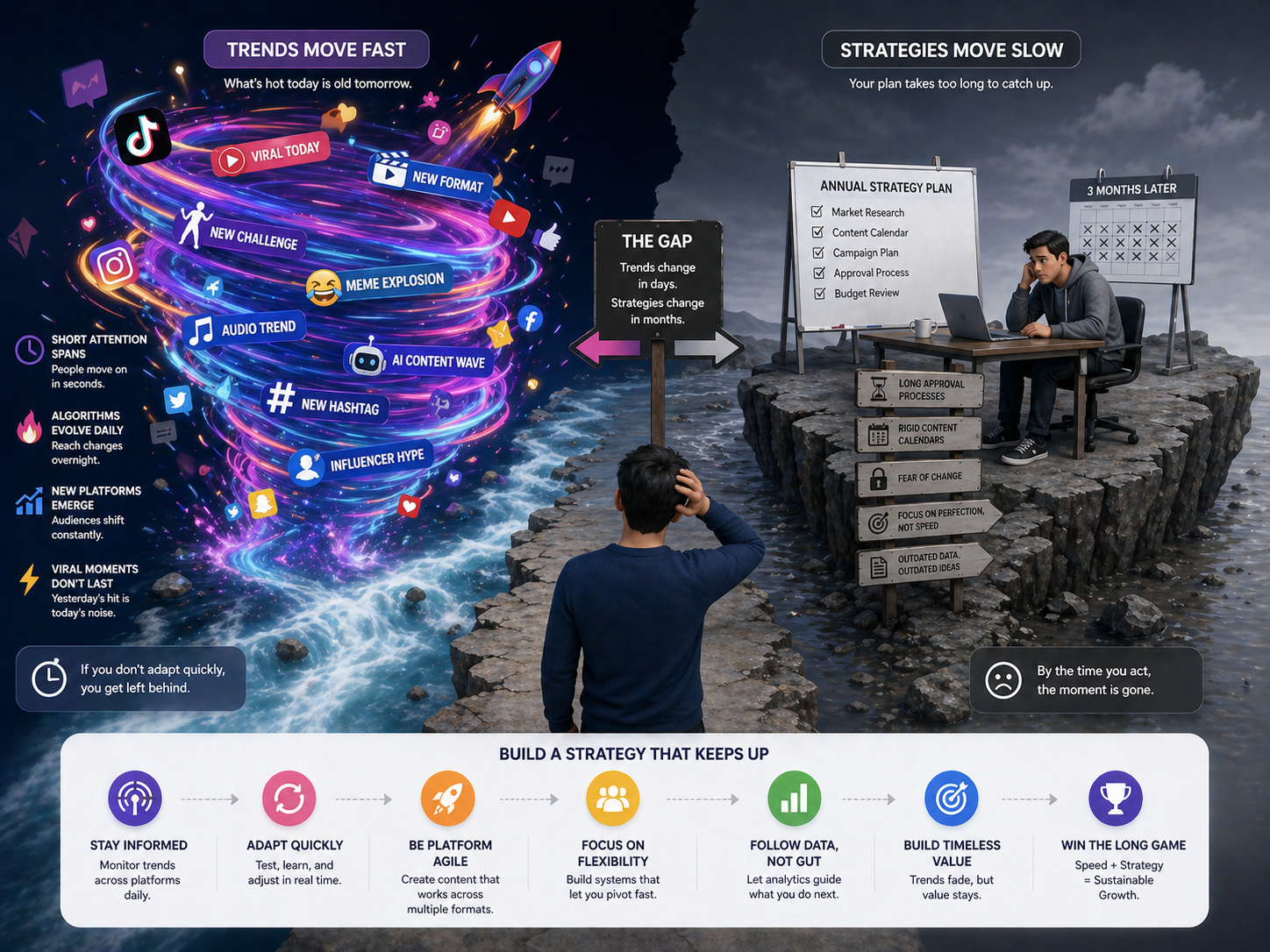
Social media moves at a speed that most strategies simply cannot match. The problem is not always the quality of the strategy. In many cases, the strategy is well thought out and structured. The real issue lies in the gap between how fast trends evolve and how slow strategies are built and executed.
The Nature of Social Media Trends
A social media trend is not just a popular topic. It is a moment driven by collective attention, shaped by algorithms, and amplified by user interaction. Trends emerge quickly because platforms prioritize content that generates engagement within a short time frame.
What makes trends even more unpredictable is their lifecycle. Some trends last for weeks, but many disappear within days or even hours. This short lifespan makes it difficult for brands that rely on long planning cycles to stay relevant.
The Strategy vs Speed Gap
Traditional marketing strategies are built on structure. They involve research, planning, approvals, and execution timelines. While this approach ensures consistency and quality, it also slows down responsiveness.
Social media, on the other hand, rewards immediacy. Content that reacts quickly to trends often performs better than content that is perfectly planned but delayed. This creates a mismatch between how strategies are built and how platforms operate.
I have personally experienced how frustrating this gap can be. You know what kind of content works, but internal processes prevent you from acting fast enough. By the time everything is approved, the opportunity is gone.
The Algorithm Effect
Algorithms play a major role in accelerating trends. Platforms like Instagram, TikTok, and others prioritize content that keeps users engaged. When a trend starts gaining traction, the algorithm pushes it to more users, creating a snowball effect.
This is why trends can explode overnight. A single piece of content can trigger thousands of variations, each contributing to the trend’s growth. However, the same mechanism also causes trends to fade quickly once engagement drops.
Relying on outdated formats or late participation often results in poor performance. The algorithm simply moves on to the next engaging content.
Audience Behavior is Constantly Shifting
Another reason trends move so fast is the audience itself. Users today consume content rapidly and move on just as quickly. Attention spans are shorter, and content fatigue is real.
Younger audiences, especially Gen Z, play a significant role in shaping trends. They value authenticity, humor, and relatability over polished content. This shifts the focus from perfection to connection.
As a result, brands that take too long to produce content often miss the emotional tone of current trends. By the time they publish, the audience has already moved on.
The Illusion of Chasing Trends
Many brands believe that the solution is to chase every trend. In reality, this approach often backfires. Not every trend aligns with your brand identity, and forcing participation can make your content feel inauthentic.
I have seen brands jump on trends that have nothing to do with their values or audience. The result is content that feels disconnected and sometimes even awkward.
Trends should not be followed blindly. They should be adapted in a way that feels natural and relevant. The goal is not just to be seen, but to be remembered for the right reasons.
How to Build a Flexible Social Media Strategy
Instead of trying to predict every trend, the focus should be on building flexibility. A strong social media strategy today is not rigid. It is adaptive.
This means creating space for real-time content. It also means empowering teams to make quick decisions without going through excessive approval layers. Data should guide actions, but it should not slow them down.
At this point, it is worth exploring how trends are shaping brand growth in more detail.
Read also : Social Media Trends Shaping Brand Growth 2026
A flexible strategy allows you to respond to trends while staying aligned with your brand. It is not about abandoning structure, but about redefining it.
The Role of Creativity Over Perfection
One of the biggest mindset shifts I have learned is that speed often matters more than perfection. Social media users are not looking for flawless content. They are looking for something that feels real and engaging.
This opens the door for experimentation. Not every piece of content needs to be a success. In fact, failure can provide valuable insights that improve future performance.
The brands that succeed are the ones that are willing to test, learn, and iterate quickly. They understand that social media is not a static environment.
Future-Proofing Your Strategy
If trends will always change quickly, how do you build a strategy that lasts?
The answer lies in systems, not rigid plans. Instead of focusing on specific content ideas, focus on creating processes that allow your team to act بسرعة and adapt easily.
Empowering your team is also crucial. When people have the authority to make decisions, they can respond to trends in real time. This reduces delays and increases relevance.
At the same time, it is important to maintain a long-term vision. Your brand identity should remain consistent even as your content evolves.
Conclusion
Social media trends will always move faster than your strategy. This is not something you can control, but it is something you can adapt to.
The key is not to chase every trend or abandon planning altogether. It is to find a balance between structure and flexibility. Build systems that allow you to move quickly, stay authentic, and connect with your audience in real time.
From my experience, the brands that thrive are not the ones with the most detailed plans. They are the ones that understand how to adapt, experiment, and evolve.